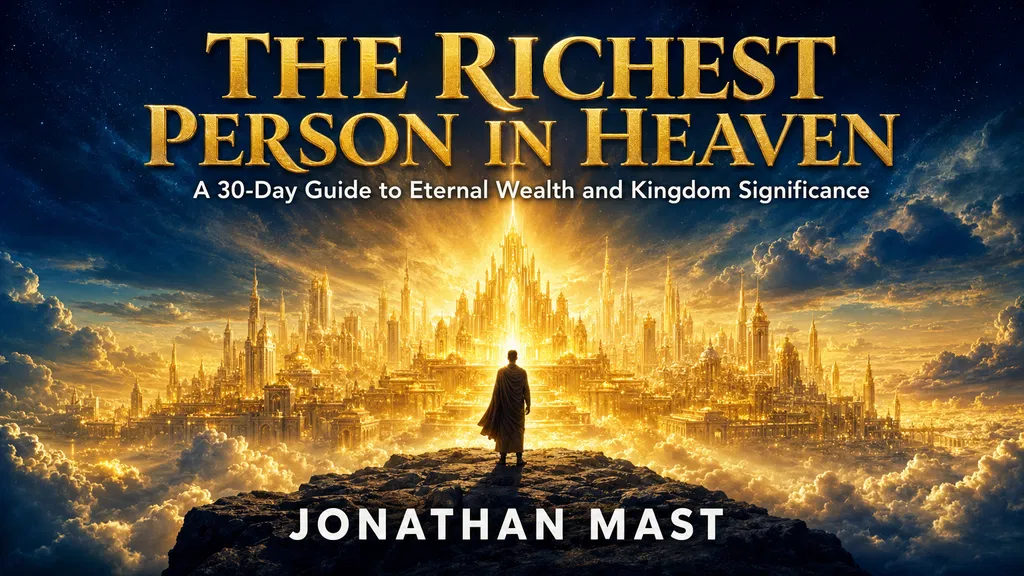
I tried it. Here is what I learned about AI, faith, and what it means to build something that actually matters.
By Jonathan Mast
I was sitting in a room full of people hungry to live for something bigger than themselves when John Maxwell asked a question that stopped me cold.
“How can I be the richest person in heaven?”
That is not a greedy question. That is an eternally strategic one. And it would not let me go.
What followed was one of the more unusual creative experiences of my life. I took that question home, opened my AI tools, and spent weeks building something I had never built before. A 30-day devotional guide. Scripture-grounded, theologically careful, personally honest. Built in collaboration with Perplexity, Manus, and Claude.
And I want to tell you exactly what that process was like, because I think most people have the wrong picture of what AI actually does when you bring it into something as sacred as your faith.
The short answer to the question in the headline: no, it is not cheating. But it is also not magic. What it is, in the right hands, is a tool that can help you go deeper than you might go alone.
Key Takeaways
- AI did not write this devotional. A question from John Maxwell inspired it. AI helped build it out.
- The conductor analogy is the right frame. AI is the orchestra. You are still the one holding the baton.
- Transparency about AI use is not a weakness. For people of faith, it is a form of integrity.
- AI can help you research Scripture, explore theology, and structure your thinking. It cannot replace the Holy Spirit or your own walk with God.
- The intersection of AI and faith is not something to fear. It is something to steward well.
The Assumption Most People Bring to This Conversation
When I told people I used AI to help write a devotional, I got one of two reactions.
The first was enthusiasm. People in my world, entrepreneurs and business owners who use AI every day, immediately got it. Tool plus human plus intentionality equals output that neither could produce alone.
The second reaction was suspicion. And I understand it. Faith is personal. Scripture is sacred. The idea of feeding a Bible verse into a chatbot and getting a devotional back feels wrong to a lot of people. It feels like outsourcing something that should be intimate.
Here is what I want to say to the second group, because I was thinking about you the entire time I was building this.
You are right that something would be wrong with that picture. But that is not what happened.
What actually happened is this. I had a question I could not shake. I had a conviction that the answer mattered. I had a body of scriptural and theological territory I wanted to explore carefully and honestly. And I used AI as a research partner, a structural aid, and a drafting tool, in the same way I might use a concordance, a commentary, or a trusted writing partner who happens to know a lot about systematic theology.
Every word in that devotional was read by me. Proofed by me. Tested against what I actually believe. I cut things that were not right. I added things the AI missed. I wrote the personal sections myself because no AI has done time in a federal prison or received a letter from an aunt that changed the direction of a season.
I am the conductor. The orchestra helped. The music is still mine.
What the Research Actually Shows About AI and Creative Work
Here is something that does not get talked about enough in the faith community.
Every tool we use to engage with Scripture is a form of technology. The printing press was a technology. The concordance was technology. Bible software is technology. The podcast you listened to this morning was about technology. None of those tools replaced the work of the Holy Spirit. They served it.
Research from the Barna Group consistently shows that the number one barrier to Bible engagement among American adults is not lack of interest. It is a feeling of being overwhelmed and not knowing where to start. People want to go deeper. They do not know how to get there.
AI does not solve that problem by replacing human engagement with Scripture. It solves it by lowering the activation energy. By making the first step feel manageable.
When I asked an AI to help me research the Bema seat, it pulled from sources I would not have found in a casual study. When I asked it to help me structure 30 days of content around a single theological thesis, it gave me a scaffold I could then fill with real content from real experience. That scaffold did not do my theology for me. It freed me to focus on the theology instead of the logistics.
There is a meaningful difference between those two things.
The Transparency Question
I want to talk about something I almost did not do.
In the final version of the devotional, there is a page called “A Note on How This 30 Day Devotional Was Written.” It tells the reader exactly which AI tools I used and exactly what role they played. It makes clear that AI did not inspire this. God did, through a question asked in a room full of hungry people. AI was simply the tool I used to build it out.
I almost cut that page.
Not because I was ashamed of it. But because I was worried it would undermine the reader’s trust in the content. I thought some people might put it down before Day 1 if they knew AI had touched it.
I kept it for two reasons.
First, because transparency matters more to me than looking impressive. That is not a new value for me. It is the value that shapes everything I teach about AI. If I hide how I built this, I am implying that how I built it is something to be hidden. And I do not believe that.
Second, because the people I most want to reach with this devotional are the same people who are wrestling with exactly this question. Can AI be a tool for good in my life? Can I bring it into the things that matter most to me, my work, my creativity, my faith, without compromising those things?
If I hide the process, I take away the evidence.
The devotional is the proof of concept. The transparency note is the case study.
How I Actually Used AI to Build This
For anyone who wants the practical picture, here is how the process worked.
I started with the question. Maxwell’s question gave me the thesis. Everything else flowed from there.
I used Perplexity to research the theological landscape. Scriptures on eternal rewards, the Bema seat, crowns in the New Testament, the parables of stewardship. I was not looking for AI to tell me what the Bible says. I was looking for a starting map of the territory so I could navigate it intentionally.
I used Claude to help me structure the 30-day arc. I wanted four thematic weeks. I wanted a consistent daily format. I had a general sense of the content I wanted to cover, and I needed help organizing it into a sequence that built logically and emotionally. That is a structural problem, not a theological one. AI is excellent at structural problems.
I used Manus to help with research and drafting on specific days where the theological content was dense and I wanted to make sure I was representing the material accurately.
Then I read every single entry. Proofed every single entry. Rewrote the sections that did not sound right or did not sit right theologically. Added my personal story in the Introduction. Added the personal reflection in Day 13 about learning generosity in a season when life was down. Wrote the dedication to my Aunt Sharon myself.
The parts that are most human in the devotional are the parts I wrote from scratch. The parts that are most structurally sound are the parts where AI did the most work. That combination is, I believe, better than either of us would have produced alone.
What This Means for You
If you are a person of faith who has been keeping AI at arm’s length because it feels incompatible with the sacred, I want to ask you to consider something.
The question is not whether a tool is spiritual or secular. Hammers built cathedrals. Presses printed Bibles. Cameras captured baptisms. The question is always what the tool is being used for and whether the person holding it is doing so with integrity and intentionality.
AI in the hands of someone who is chasing clicks and cutting corners will produce shallow content. AI in the hands of someone who is genuinely seeking truth, wrestling with Scripture, and checking every output against what they actually believe, that combination can produce something worth reading.
I cannot prove to you that the devotional I built is the second category. You will have to read it and decide for yourself.
But I can tell you that I prayed over it. I argued with it. I edited it. I submitted it to people I trust. And when it was done, I felt the same way I feel after any piece of work I am genuinely proud of: like I gave it everything I had, with the best tools available to me.
That is all any of us can do.
Frequently Asked Questions
Does using AI to write a devotional make it less spiritually valid?
I do not think the tool determines the validity. The theology, the Scripture, the integrity of the person producing it, those things determine the validity. A devotional written entirely by hand by someone with bad theology is less useful than one built carefully with AI by someone who checked every word against Scripture.
How do you make sure AI does not get the theology wrong?
You read it. Every word. You test it against what you actually believe and what the Bible actually says. AI is a drafting tool, not an authority. The responsibility for theological accuracy belongs to the human, not the model.
Is this just a shortcut?
Shorter is not always shallower. The AI helped me cover more theological ground more carefully than I could have covered alone in the same timeframe. A shortcut implies you skipped something important. I did not skip anything. I moved faster.
What if someone reads this devotional and finds an error?
I said this in the devotional itself. If it accurately represents Biblical perspectives, give God the glory. If it falls short, that is on me. I am not a pastor. I am a self-proclaimed Jesus Freak doing my best with the tools and the time I have.
Will you use AI for faith-based content again?
Yes. Without hesitation. With the same level of care.
The Richest Person in Heaven Starts Building Today
I did not write a devotional to prove a point about AI.
I wrote it because a question stopped me cold in a room full of people, and I could not let it go. I used AI because it is the best tool I have for turning a conviction into a finished thing. And I am sharing both the devotional and the process because I believe the people in my world deserve to see both.
We are building for eternity. Every day. With every decision. With every tool in our hands.
The only question that matters is whether we are building with integrity.
Download the devotional below. Read Day 1 today. And if the AI question is still bothering you, read the note on page 3 first. I think it will settle something.