
The business world is witnessing a replay of one of history’s most catastrophic strategic failures1. Just as Kodak invented the digital camera in 1975 yet chose to suppress it to protect their film profits, today’s executives are sitting on transformative AI capabilities while clinging to outdated operational models2. This isn’t just another technology trend—it’s an existential moment that will separate tomorrow’s market leaders from yesterday’s cautionary tales3.
The data is unforgiving: only 26% of companies are extracting tangible value from AI initiatives, while 42% are abandoning their AI projects entirely910. Meanwhile, AI leaders are achieving 1.5 times higher revenue growth and 1.6 times greater shareholder returns than their traditional counterparts9. The performance gap isn’t narrowing—it’s accelerating into a chasm that will be impossible to bridge.
Written in collaboration with Perplexity Labs.

Visual metaphor comparing Kodak’s missed digital opportunity to today’s AI transformation challenge
The Kodak Catastrophe: A Strategic Autopsy
Kodak’s downfall wasn’t due to technological blindness—it was strategic cowardice12. In 1975, Kodak engineer Steve Sasson invented the world’s first digital camera, only to hear management respond with “that’s cute—but don’t tell anyone about it”2. The company possessed over 1,000 digital patents and held an 80% market share in film by 1990, yet systematically chose short-term profits over long-term survival37.
The timeline reveals a pattern of strategic denial that modern executives should find chilling14. From 1975 to 2003, Kodak had nearly three decades to transition from film to digital leadership8. Instead, they made half-hearted attempts while competitors like Sony, Canon, and Nikon aggressively pursued digital innovation57. By 2012, this once-dominant $31 billion company filed for bankruptcy, having squandered the greatest technological head start in corporate history13.
Kodak AI Strategic Comparison
| Technology_Phase | Kodak_Digital_Timeline | Kodak_Response | AI_Current_Status | Strategic_Implications |
|---|---|---|---|---|
| Invention/Early Development | 1975 – Invented digital camera | Suppressed invention | 2010s – Foundation models developed | Early mover advantage available |
| Market Recognition | 1984-1994 – Limited digital products | Minimal investment | 2022-2023 – ChatGPT breakthrough | Investment window opening |
| Mainstream Adoption | 1990s-2000s – Competitors embrace digital | Half-hearted adoption | 2024-2025 – Widespread deployment | Competitive differentiation begins |
| Market Dominance | 2003-2007 – Failed transformation attempts | Too little, too late | 2025-2027 – Competitive advantage period | Market leadership determined |
| Disruption Complete | 2012 – Bankruptcy filing | Market irrelevance | 2028-2030 – New market leaders emerge | Winners and losers established |
The lesson isn’t about technology—it’s about leadership courage48. Kodak’s executives knew digital photography would eventually cannibalize film sales, but they lacked the strategic fortitude to disrupt their own cash cow26. They chose comfort over competition, protection over progress, and incremental thinking over exponential opportunity.
The AI Mirror: History’s Echoes in Today’s Boardrooms
The parallels between Kodak’s digital denial and today’s AI resistance are striking and terrifying1718. We’re witnessing the same strategic patterns: executive teams acknowledging AI’s potential while failing to commit the resources and organizational changes necessary for transformation1929. The window for competitive advantage is rapidly closing, and the majority of organizations are sleepwalking toward irrelevance.
Current AI adoption statistics reveal a brutal reality911. While 74% of organizations have implemented some AI-based solutions, only 33% have embedded them company-wide15. The gap between AI experimentation and AI transformation is where competitive futures are decided2829. Companies are treating AI like a side project rather than the core strategic imperative it represents.
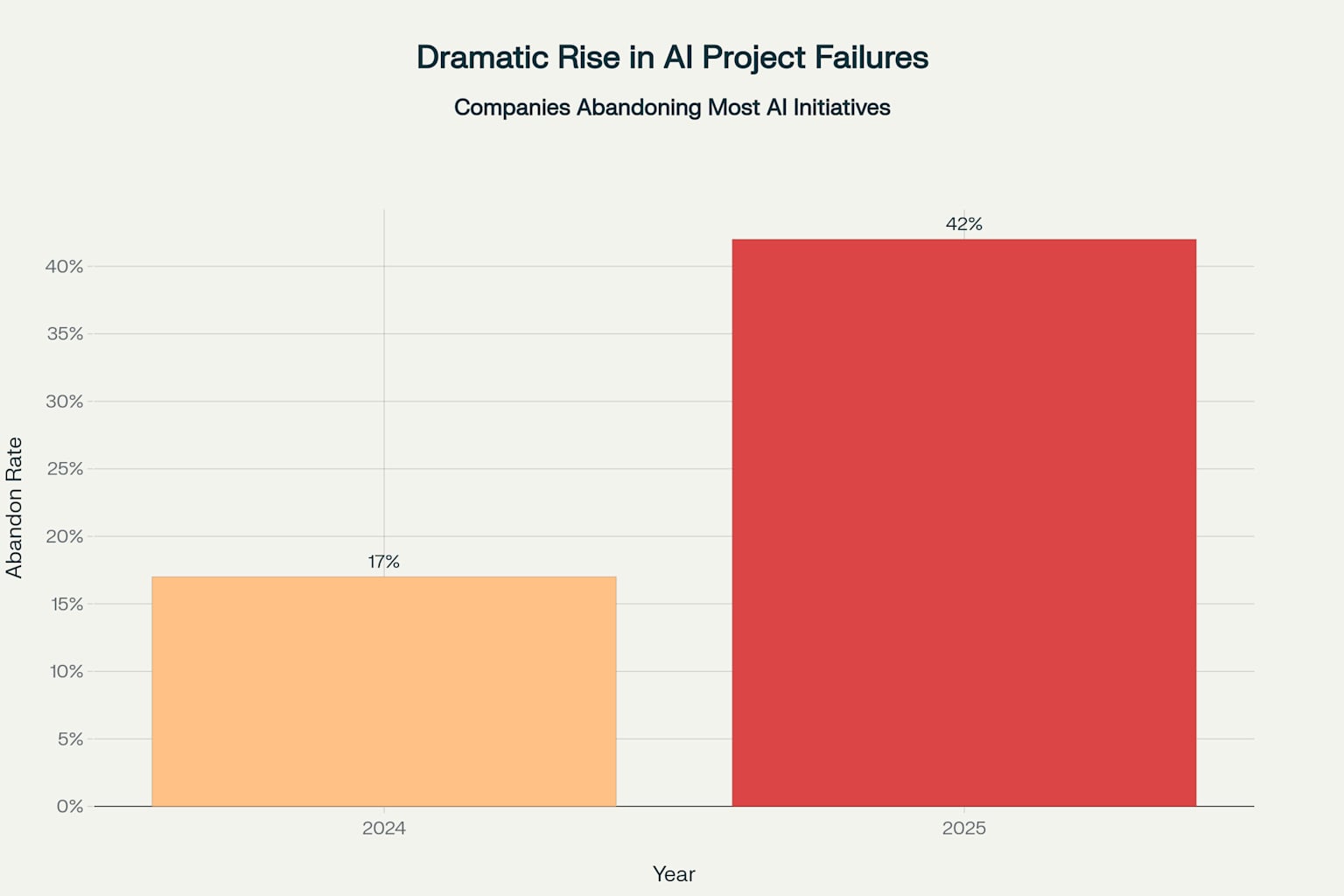
AI project failure rates have more than doubled from 2024 to 2025, showing the growing difficulty companies face in successfully implementing AI initiatives
The failure rate acceleration from 17% to 42% in just one year exposes the harsh truth: most organizations lack the strategic discipline and operational excellence to execute AI transformation1011. They’re approaching AI with the same incremental mindset that destroyed Kodak—testing around the edges while competitors rebuild their entire operational foundation.
The Great Divergence: Performance Data That Demands Action
The performance gap between AI leaders and laggards isn’t just emerging—it’s exploding924. AI-adopting organizations are achieving 1.8 times faster innovation rates, 1.7 times quicker time-to-market, and 1.6 times greater market share expansion compared to traditional businesses2425. This isn’t gradual competitive advantage—it’s exponential market domination.
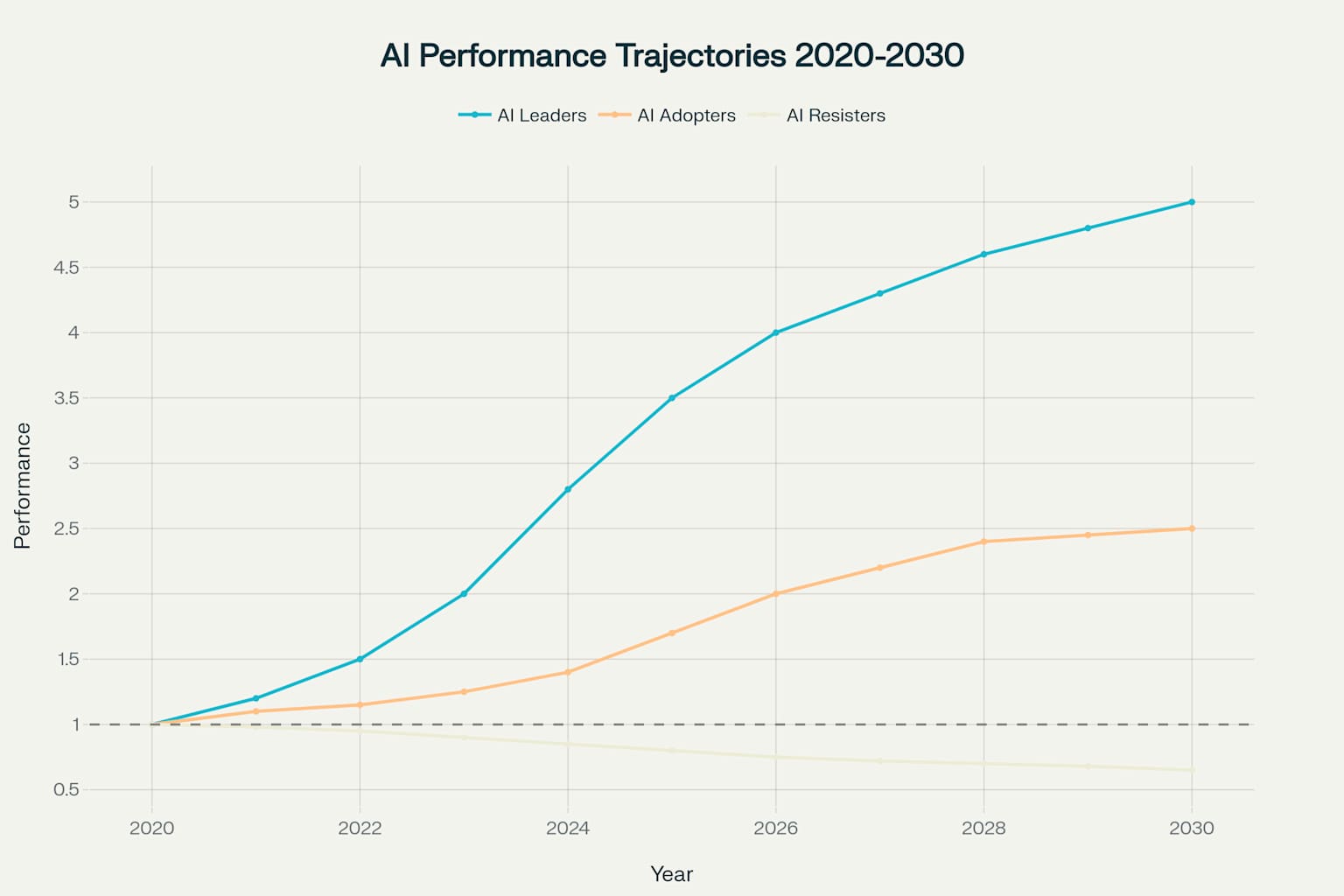
AI adoption strategy creates a massive performance divergence, with leaders achieving 5x performance while resisters decline to 65% of baseline
Business Impact Comparison
| Performance_Metric | AI_Leaders_Multiplier | Traditional_Baseline | Competitive_Gap |
|---|---|---|---|
| Revenue Growth Rate | 1.5 | 1.0 | 0.5 |
| Market Share Expansion | 1.6 | 1.0 | 0.6 |
| Operational Efficiency | 1.4 | 1.0 | 0.4 |
| Innovation Speed | 1.8 | 1.0 | 0.8 |
| Customer Satisfaction | 1.3 | 1.0 | 0.3 |
| Employee Productivity | 1.4 | 1.0 | 0.4 |
| Cost Reduction | 1.3 | 1.0 | 0.3 |
| Time to Market | 1.7 | 1.0 | 0.7 |
The trajectory data reveals an uncomfortable truth: AI resistance leads to performance decline, not just stagnation2023. While AI leaders achieve 5x performance multipliers by 2030, resisters face a downward spiral to 65% of baseline performance2123. This isn’t a zero-sum game—it’s a negative-sum catastrophe for organizations that fail to act decisively.
The financial implications are staggering916. AI leaders are generating 150% higher revenue growth and 160% greater shareholder returns than traditional competitors9. These aren’t marginal improvements—they’re market-redefining advantages that compound over time. Organizations waiting for AI to “mature” are actually waiting for their own obsolescence.
Strategic Imperatives: The Leadership Response
The AI transformation requires executive courage that most leaders lack1929. It demands the same disruptive mindset that Kodak’s management failed to demonstrate: the willingness to cannibalize existing business models before competitors do it for you2231. This isn’t about adopting AI tools—it’s about rebuilding organizational DNA around artificial intelligence capabilities.
Successful AI transformation requires three non-negotiable elements2934. First, strategic alignment that integrates AI into core business objectives rather than treating it as a departmental initiative1929. Second, comprehensive organizational change that addresses culture, processes, and talent simultaneously1429. Third, sustained financial commitment that prioritizes long-term competitive advantage over short-term profit protection2936.
The barriers to AI adoption—leadership resistance (43%), lack of vision (37%), and legacy system dependence (33%)—are symptoms of strategic cowardice, not technological limitations1214. Organizations that overcome these barriers through decisive leadership action position themselves as tomorrow’s market dominators2324.
AI Adoption Statistics
| Metric | Percentage | Source |
|---|---|---|
| Companies with tangible AI value | 26 | BCG Research 2024 |
| Companies abandoning AI initiatives (2024) | 17 | S&P Global Market Intelligence |
| Companies abandoning AI initiatives (2025) | 42 | S&P Global Market Intelligence |
| Average AI project failure rate | 46 | S&P Global Market Intelligence |
| AI leaders revenue growth advantage | 150 | BCG Research |
| AI leaders shareholder return advantage | 160 | BCG Research |
| Companies increasing AI investment | 94 | Ramp Analysis |
| Executive decision distress rate | 85 | Business Leadership Survey |
| AI vs traditional performance gap | 250 | Multiple Studies |
The Competitive Intelligence Advantage
AI’s impact on competitive intelligence and strategic decision-making represents the ultimate irony for AI resisters3235. While traditional organizations struggle with “decision distress” affecting 85% of executives, AI-powered leaders are making faster, more accurate strategic decisions based on real-time market intelligence3234. They’re not just competing better—they’re competing in an entirely different league.
The democratization of AI-driven competitive intelligence means that organizational size no longer determines market advantage2035. Smaller, AI-powered companies are outmaneuvering industry giants through superior data analysis, predictive capabilities, and operational efficiency2025. The competitive landscape is being fundamentally rewritten, and traditional market leaders are becoming irrelevant.
The Verdict: Transform or Perish
The AI transformation window is closing rapidly, and the consequences of inaction are becoming irreversible1528. Just as Kodak’s digital photography patents became worthless after market disruption, today’s organizational advantages mean nothing without AI integration123. The question isn’t whether AI will reshape your industry—it’s whether your organization will lead that transformation or become its casualty.
The strategic choice is binary: embrace AI transformation with the same urgency and commitment that successful companies applied to digital transformation, or accept inevitable market irrelevance1721. There’s no middle ground, no gradual transition, and no second chances. The companies that act decisively in the next 18 months will establish competitive advantages that persist for decades1829.
The Kodak lesson is clear: technological innovation without strategic courage leads to corporate extinction12. Today’s leaders have the same choice Kodak’s executives faced—protect the present or create the future48. The difference is that we now have the historical precedent to understand the consequences of choosing wrong. The question is whether we have the leadership courage to choose right.
- https://cdotimes.com/2023/09/27/case-study-kodaks-downfall-a-lesson-in-failed-digital-transformation-and-missed-opportunities/
- https://www.forbes.com/sites/chunkamui/2012/01/18/how-kodak-failed/
- https://www.linkedin.com/pulse/rise-fall-kodak-how-photography-giant-lost-its-way-rahul-bhole-tq1hc
- https://shuffleplay.no/2023/12/09/debunking-the-kodak-myth-bankruptcy-disruption-and-inability-to-adapt/
- https://trellispoint.com/blog/kodaks-digital-revolution-miss-ungrowth-in-product-innovation-the-ungrowthe-show-episode-recap
- https://kellerink.com/blogs/news/kodak-s-moment-the-rise-and-fall-of-the-camera-king
- https://yourstory.com/2023/10/kodaks-downfall-digital-reluctance
- https://www.linkedin.com/pulse/kodaks-strategic-orientation-lessons-failure-revival-kolluru–mid7f
- https://www.bcg.com/press/24october2024-ai-adoption-in-2024-74-of-companies-struggle-to-achieve-and-scale-value
- https://fortune.com/2025/06/11/ai-companies-employee-fatigue-failure/
- https://www.ciodive.com/news/AI-project-fail-data-SPGlobal/742590/
- https://www.nttdata.com/global/en/insights/focus/2024/between-70-85p-of-genai-deployment-efforts-are-failing
- https://www.rapidops.com/blog/ai-success-stories-what-is-driving-ai-adoption/
- https://itsoli.ai/the-human-side-of-ai-transformation-tackling-resistance/
- https://www.ataccama.com/news/data-trust-report-2025-ai
- https://blogs.microsoft.com/blog/2025/04/22/https-blogs-microsoft-com-blog-2024-11-12-how-real-world-businesses-are-transforming-with-ai/
- https://whatfix.com/blog/disruptive-technology/
- https://tang.technology/2024/07/09/technology-disruption/
- https://www.linkedin.com/pulse/30-club-why-most-digital-transformations-fail-how-ai-turner-mba-wuptc
- https://www.forbes.com/sites/glenngow/2024/05/12/ais-competitive-advantage-for-small-and-medium-enterprises/
- https://www.rethinkx.com/blog/the-pattern-of-disruption
- https://digitaldefynd.com/IQ/digital-transformation-failure-examples/
- https://www.pypestream.com/blog/why-businesses-need-to-embrace-ai-for-competitive-advantage
- https://www.isixsigma.com/artificial-intelligence/case-studies-companies-successfully-using-ai-to-innovate/
- https://cloud.google.com/transform/101-real-world-generative-ai-use-cases-from-industry-leaders
- https://appinventiv.com/blog/artificial-intelligence-case-studies/
- https://www.growthjockey.com/blogs/ai-case-study
- https://tiledesk.com/blog/the-cost-of-falling-behind-ai-adoption-challenges-and-the-tiledesk-solution/
- https://www.linkedin.com/pulse/navigating-ai-landscape-strategic-blueprint-business-leaders-creasey-sokic
- https://www.phenom.com/blog/examples-companies-using-ai-recruiting-platform
- https://www.forbes.com/sites/lindsaykohler/2025/01/27/fear-isnt-slowing-down-ai-adoption-at-work-a-lack-of-vision-is/
- https://quantive.com/resources/articles/ai-for-decision-making
- https://www.innovationstrategy.com/article/ai-in-executive-decision-making
- https://www.linkedin.com/pulse/how-ai-transforming-decision-making-business-leaders-daniel-chlad-gcyne
- https://relevanceai.com/agent-templates-tasks/competitive-intelligence-ai-agents
- https://www.middletonprivatecapital.co.uk/ai-in-2024-winners-losers-and-the-next-frontiers-in-the-stock-market/
- https://www.octopusintelligence.com/ai-in-competitive-intelligence-and-market-research-what-its-good-for/
- https://iot-analytics.com/leading-generative-ai-companies/
- https://en.wikipedia.org/wiki/Kodak
- https://photopxl.com/the-story-of-kodaks-fall-by-ai/
- https://www.mckinsey.com/capabilities/quantumblack/our-insights/the-state-of-ai
- https://www.winssolutions.org/counter-resistance-against-transformative-ai/
- https://en.wikipedia.org/wiki/Disruptive_innovation
- https://galileo-unbound.blog/2023/04/12/from-coal-and-steam-to-chatgpt-chapters-in-the-history-of-technology/
- https://www.forbes.com/sites/stevedenning/2014/06/24/understanding-disruption-insights-from-the-history-of-business/
- https://www.linkedin.com/pulse/case-studies-successful-generative-ai-adoption-techstack-limited-0u8nf
- https://cmitsolutions.com/rochester-ny-1109/blog/the-impact-of-ai-on-business-strategy-what-leaders-need-to-know/
- https://datasociety.com/ai-for-executives-a-strategic-guide-to-data-driven-leadership
- https://hbr.org/2023/10/how-ai-can-help-leaders-make-better-decisions-under-pressure
- https://learning.asu.edu/newsroom/the-future-of-learning/executive-education-in-ai/