

Introduction: Navigating the AI Upgrade Cycle
The constant stream of AI model updates has become a familiar rhythm in the tech world. For entrepreneurs, this cycle presents a recurring strategic question: when is an upgrade a genuine business advantage versus just incremental noise? Each new version number from OpenAI, Google, or Anthropic demands a clear-eyed evaluation, separating the marketing hype from measurable gains in productivity and capability.
This brings us to the central question of this article: Is ChatGPT 5.2 a meaningful leap forward for business, or just another version number in an increasingly crowded field?
Based on the official announcements from OpenAI, GPT-5.2 represents a targeted evolution focused on professional reliability and complex task execution. While not a complete paradigm shift, it is a noteworthy development for specific business applications, engineered to be more accurate, more capable in multi-step workflows, and better at producing tangible professional outputs like code and spreadsheets.
What Entrepreneurs Should Pay Attention To
This is a high-level briefing on the most strategically relevant changes in GPT-5.2 for business leaders.
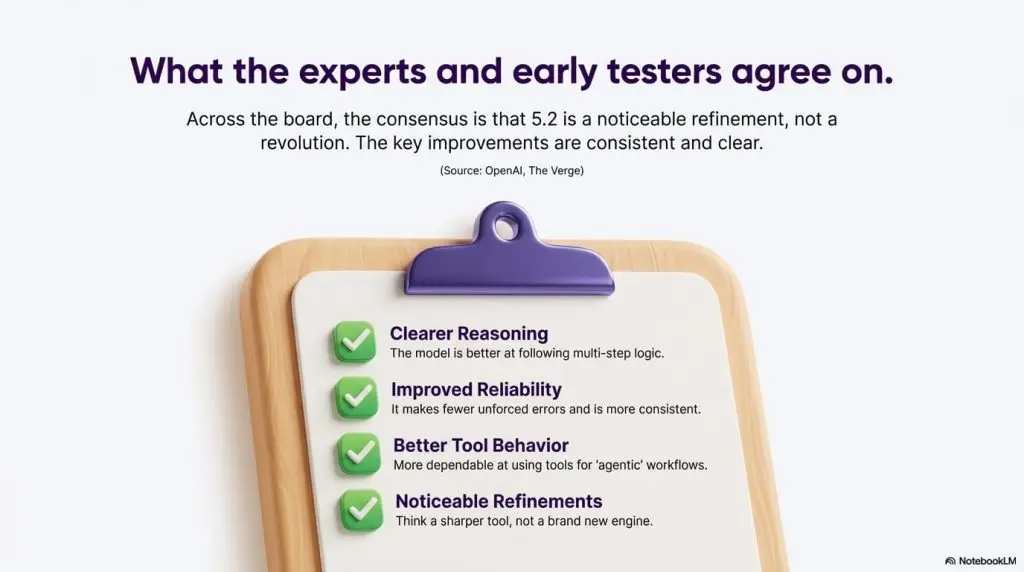
- A Focus on Professional Reliability: GPT-5.2 is engineered to “hallucinate less” and produce fewer errors. According to OpenAI’s internal testing, responses with errors were “30%rel less common,” and the model’s deception rate in production traffic dropped significantly to 1.6% from 7.7% in GPT-5.1 (OpenAI, OpenAI System Card).
- Enhanced “Agentic” Workflow Capabilities: In a business context, an “agentic” workflow involves automating complex, multi-step projects. GPT-5.2 features improved tool-calling performance and a greater ability to manage long-running tasks. As AJ Orbach, CEO of Triple Whale, noted, “We collapsed a fragile, multi-agent system into a single mega-agent… it just works” (OpenAI, The Verge).
- Tangible Improvements in Business Outputs: The update delivers specific advancements in creating professional artifacts. It achieves state-of-the-art performance on the GDPval benchmark, where it “beats or ties top industry professionals on 70.9% of comparisons on… knowledge work tasks” like generating spreadsheets and presentations (OpenAI).
- A Tiered System for Different Use Cases: OpenAI released three model variants—Instant, Thinking, and Pro. This offers a strategic choice for entrepreneurs to balance speed, cost, and analytical depth, matching the right tool to the right task (TechCrunch, OpenAI).
- A Clear Increase in API Costs: The API price for the primary GPT-5.2 model has increased by 40%, from $1.25 to $1.75 per 1M input tokens and $10 to $14 per 1M output tokens. However, OpenAI argues that its greater token efficiency may lead to a lower total cost for achieving a specific quality level (OpenAI, Reddit).
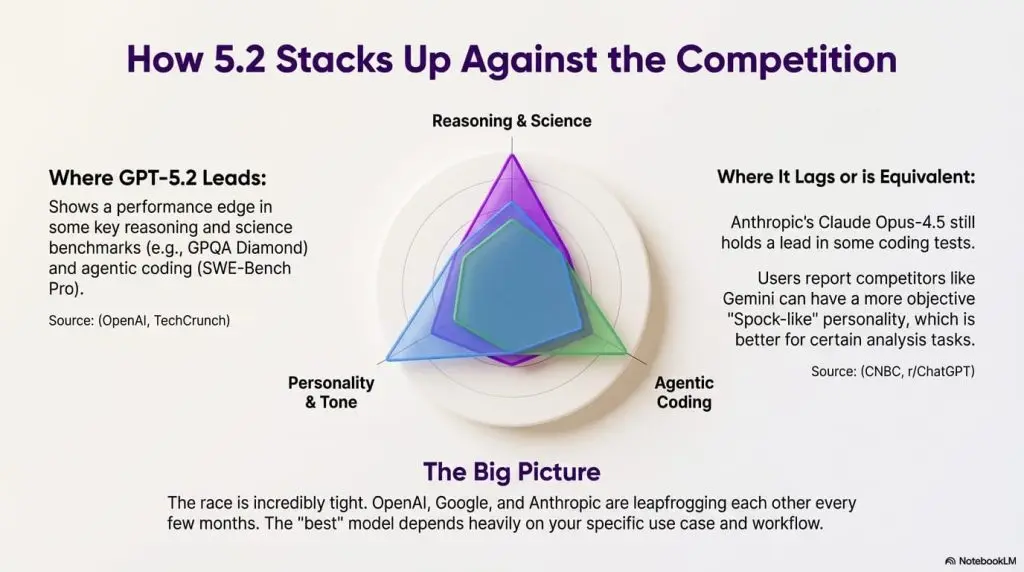
- The Competitive Market Context: This release is part of an industry-wide push, with OpenAI reportedly in a “code red” effort to compete with rivals like Google’s Gemini. For entrepreneurs, this signals a rapidly maturing market that is producing more powerful and specialized tools (TechCrunch, CNBC).
Main Analysis: A Pragmatic Framework for Evaluation
A. Why Every Update Deserves Investigation
Evaluating new AI requires a strategic mindset that moves beyond hype to identify tangible competitive advantages. It’s about quantifying the return on investment in time, cost, and efficiency. According to OpenAI, the average ChatGPT Enterprise user already saves “40–60 minutes a day” on tasks (OpenAI, The Verge). GPT-5.2 is an attempt to deepen that economic value by making the tool more dependable for higher-stakes professional work.
B. What the Sources Actually Reveal About 5.2
The specific performance improvements documented by OpenAI translate directly into business benefits.
| Business Function (Benchmark) | Implication for Entrepreneurs |
| Professional Document Creation (GDPval) | Faster and more accurate creation of business documents like presentations, financial models, and workforce plans. |
| Software Development & Prototyping (SWE-Bench Pro) | More reliable AI assistance for development teams, reducing time spent on debugging and implementing new features, especially for front-end UI. |
| Complex Document Analysis (OpenAI MRCRv2) | Ability to accurately analyze and synthesize information from very long documents, such as legal contracts, research papers, or extensive reports. |
| Visual Data Interpretation (CharXiv & ScreenSpot-Pro) | Better interpretation of visual data, allowing for more accurate analysis of dashboards, technical diagrams, and software screenshots. |
| Automated Workflow Execution (Tau2-bench Telecom) | Enables the creation of more robust automated agents that can handle complex, multi-step workflows like a complete customer service ticket resolution. |
- Coding & Development: GPT-5.2 sets a new state-of-the-art score on SWE-Bench Pro, a benchmark for real-world software engineering tasks. It also demonstrates an improved ability to create front-end UI from a single prompt, which can significantly accelerate prototyping for development teams (OpenAI).
- Data & Document Analysis: The model shows a significant improvement in long-context reasoning, achieving near-100% accuracy on the 4-needle MRCR variant. For entrepreneurs, this means the AI can reliably find and integrate specific pieces of information spread across hundreds of thousands of words, making it invaluable for due diligence, contract review, or market research (OpenAI).
- Visual Information Processing: With error rates on chart reasoning and software interface understanding cut “roughly in half,” GPT-5.2 is far better at processing visual information. This allows it to more accurately interpret financial dashboards, technical diagrams, and product screenshots, supporting workflows where visual data is critical (OpenAI).
C. A Framework for Evaluating AI Benefits
To cut through the marketing, I advise my clients to use a simple conceptual model: the R.A.R.E. Framework. This forces a disciplined evaluation of any new AI tool against core business needs.
- Reliability: For professional use, trust is non-negotiable. GPT-5.2 was specifically engineered to be more reliable. The rate of responses containing one or more major incorrect claims dropped from 8.8% in GPT-5.1 to 5.8% in GPT-5.2 when browsing is enabled, according to OpenAI’s System Card.
- Applicability: Can the tool handle real-world, complex business workflows? GPT-5.2’s state-of-the-art tool-calling performance (98.7% on Tau2-bench Telecom) is direct evidence of its improved ability to orchestrate multi-step processes, making it more applicable to end-to-end automation (OpenAI).
- Return on Investment: The 40% API price increase presents a clear decision point. Your evaluation must determine if the reduction in errors—requiring fewer re-runs and less manual oversight—and the model’s ability to achieve the desired output with shorter, less complex prompts, genuinely offsets the higher per-token cost for your specific high-value workflows.
- Effort to Implement: The tiered system allows entrepreneurs to match the tool to the task’s complexity. The speed-optimized ‘Instant’ model can handle routine tasks efficiently, while the more powerful ‘Thinking’ or ‘Pro’ models can be reserved for deep analytical work, optimizing both cost and performance (OpenAI, TechCrunch).
D. Where Expectations Should Be Grounded
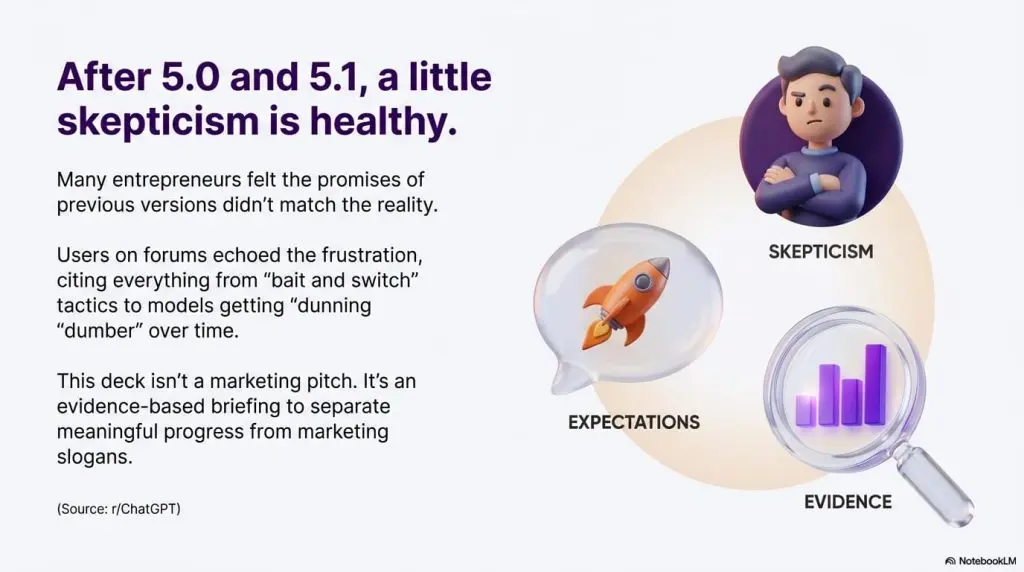
It’s crucial to maintain a realistically cautious tone. GPT-5.2 is best understood as a specialized, high-performance power tool that still requires a skilled operator, not a fully autonomous magic box. User sentiment on platforms like Reddit reflects this, with some expressing concerns about gradual rollouts, the perception of models being scaled back after an initial launch (the “bait and switch” feeling, where users notice performance degradation weeks after a powerful debut), and the persistence of safety guardrails that can sometimes interfere with professional tasks (Reddit).
Ultimately, even with its improvements in factuality, OpenAI’s own advisory remains the best practice: “For anything critical, double check its answers” (OpenAI).
E. What 5.2 Means for Entrepreneurial Strategy
Here are three practical business scenarios where GPT-5.2’s specific improvements could be applied:
- For the Solo Consultant: A solo market research consultant can now ingest a 500-page M&A due diligence report and, using GPT-5.2’s near-perfect long-context recall, produce a validated risk-assessment slide deck in under 90 minutes—a task that previously required a junior analyst two full days.
- For the Startup Founder: A bootstrapped SaaS founder can now generate three distinct, production-ready React component libraries for a new user dashboard from a single detailed prompt. This accelerates the A/B testing cycle from weeks to a single afternoon, allowing for faster product-market fit validation.
- For the Small Business Owner: A small business can deploy a more robust automated agent that handles a complete customer support workflow. The agent can now autonomously coordinate a multi-tool process: authenticating a user via CRM data, processing a refund through a payment gateway, and logging a detailed resolution ticket in a helpdesk, with a 98.7% success rate on complex telecom-style tasks.
Frequently Asked Questions
- What is the practical difference between GPT-5.2’s “Thinking” and “Pro” models?
The “Thinking” model is for complex daily work like coding and analysis, while “Pro” uses maximum compute for the most difficult problems where accuracy is paramount. Pro is designed for situations where a higher-quality answer is worth a longer wait. - Can I start using GPT-5.2 today?
It is available now for developers via the API and is rolling out gradually to paid ChatGPT plans. Users with Plus, Pro, Enterprise, and other paid tiers will see it appear over time, but it may not be available to everyone immediately. - How can I justify the higher API cost?
You can justify the cost if the model’s greater efficiency and accuracy reduce the total expense for achieving a high-quality result. OpenAI claims that because it requires fewer attempts and less manual correction, the cost to get a desired output may be lower despite the higher per-token price. - How much more “trustworthy” is GPT-5.2?
It is significantly more trustworthy for professional work, but not infallible. Internal tests show a 30% reduction in responses with errors and a drop in the production deception rate from 7.7% to 1.6%, though OpenAI still advises verifying critical outputs. - Does this update improve image generation capabilities?
No, this update did not focus on improving image generation. The sources state this is a key priority for a future release, but it was not part of the GPT-5.2 launch.
Final Thoughts: From General Experimentation to Targeted Application
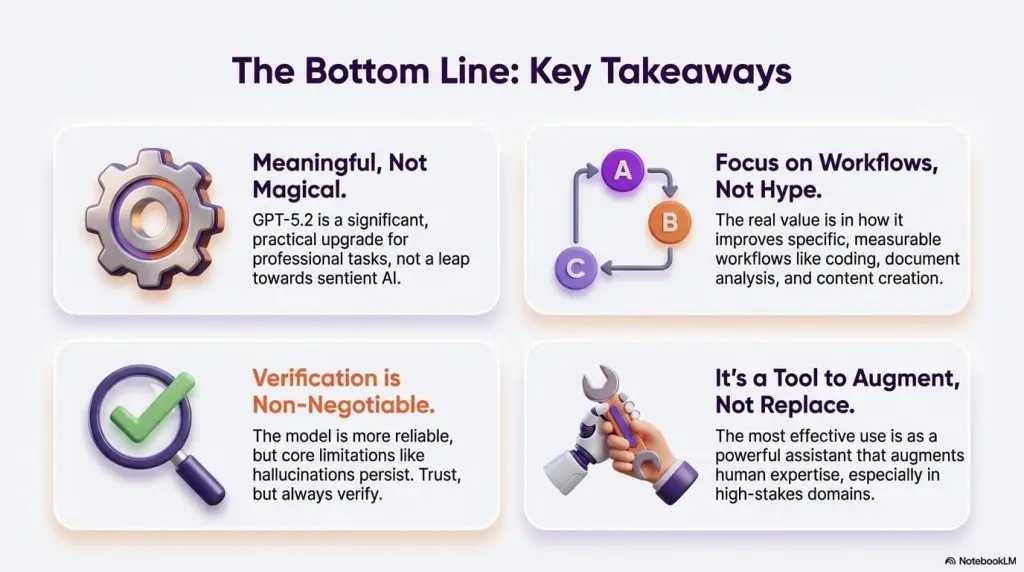
GPT-5.2 is not a revolution that redefines AI. Instead, it signals the maturation of AI into a more reliable and specialized professional tool. Its launch is part of a broader industry trend—the “agentic AI battle”—where the ultimate goal is to create AI that can reliably execute complex, real-world business tasks from end to end (The Verge).
For entrepreneurs, this marks a strategic turning point. The time for broad, general experimentation is giving way to a more focused approach. Your immediate task is to identify one or two high-value, complex workflows within your business—be it financial modeling, software prototyping, or multi-system data analysis—and launch targeted pilot projects to test GPT-5.2’s real-world impact. Using a framework like R.A.R.E. can provide the structure needed to measure its true value.
The question is no longer a general ‘What can AI do?’ but a specific ‘What critical business process can a more reliable AI solve?’ Your answer will determine your competitive edge.