

Overview
This post analyzes OpenAI’s new prompting guide for GPT-4.1 models to validate the position that prompting remains critically important with newer AI models, contrary to predictions that its importance would diminish.
Key Evidence from OpenAI’s Prompting Guide
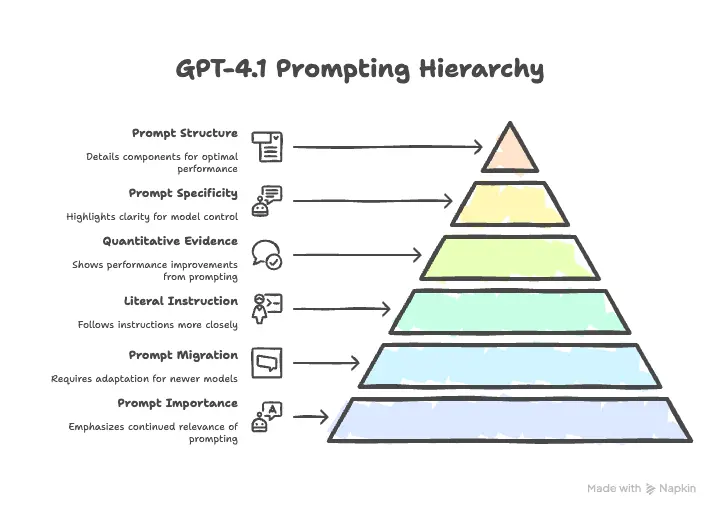
1. Explicit Statements on AI Prompt Importance
The guide begins with a clear statement emphasizing the continued importance of prompting:
“Many typical best practices still apply to GPT-4.1, such as providing context examples, making instructions as specific and clear as possible, and inducing planning via prompting to maximize model intelligence.”
This directly contradicts the notion that prompting would become less important with newer models.
2. Need for AI Prompt Migration and Adaptation
The guide explicitly states that getting the most out of GPT-4.1 requires prompt migration:
“However, we expect that getting the most out of this model will require some prompt migration.”
This indicates that not only is prompting still important, but it requires specific adaptation for newer models.
3. Increased Literal Instruction Following
The guide highlights a key characteristic of GPT-4.1:
“GPT-4.1 is trained to follow instructions more closely and more literally than its predecessors, which tended to more liberally infer intent from user and system prompts.”
This suggests that precise prompting is even more critical with GPT-4.1, as the model relies more heavily on explicit instructions rather than inferring user intent.
4. Quantitative Evidence of AI Prompt Impact
The guide provides multiple instances of quantitative improvements resulting from prompt engineering:
- 20% Performance Increase: “The model adhered closely to these three simple instructions and increased our internal SWE-bench Verified score by close to 20%”
- 2% Improvement in Tool Usage: “In our own experiments, we observed a 2% increase in SWE-bench Verified pass rate when using API-parsed tool descriptions versus manually injecting the schemas into the system prompt.”
- 4% Improvement from Planning Prompts: “In our experimentation with the SWE-bench Verified agentic task, inducing explicit planning increased the pass rate by 4%.”
These metrics provide concrete evidence that proper prompting techniques yield significant performance improvements.
5. Emphasis on AI Prompt Specificity and Clarity
The guide repeatedly emphasizes the importance of clear, specific prompts:
“GPT-4.1 is highly steerable and responsive to well-specified prompts – if model behavior is different from what you expect, a single sentence firmly and unequivocally clarifying your desired behavior is almost always sufficient to steer the model on course.”
This indicates that prompt clarity and specificity are crucial levers for controlling model behavior.
6. Detailed AI Prompt Components and Structure
The guide dedicates significant attention to specific prompt components and structures, including:
- System Prompt Reminders (Persistence, Tool-calling, Planning)
- Tool Calls with clear naming and descriptions
- Prompting-Induced Planning & Chain-of-Thought
The level of detail provided for these components underscores their importance in maximizing model performance.
Validation of User’s Position
The evidence from OpenAI’s GPT-4.1 Prompting Guide strongly validates the user’s position that prompting remains critically important with newer AI models, and may even be more important than with previous generations. The guide demonstrates that:
- Prompt Engineering Yields Measurable Improvements: Multiple quantitative metrics show significant performance gains from proper prompting techniques.
- Model Behavior Is Highly Dependent on Prompt Quality: The guide emphasizes that GPT-4.1 is “highly steerable” through well-specified prompts.
- Newer Models Require More Precise Instructions: GPT-4.1’s tendency to follow instructions more literally means that prompt precision is even more critical than with previous models.
- Prompt Structure and Components Matter: The guide’s detailed recommendations for prompt components and structure indicate that prompting is not becoming simpler or less important.
- Prompt Migration Is Necessary: The explicit recommendation for “prompt migration” contradicts the notion that prompting would become less important or standardized with newer models.
Final Thoughts
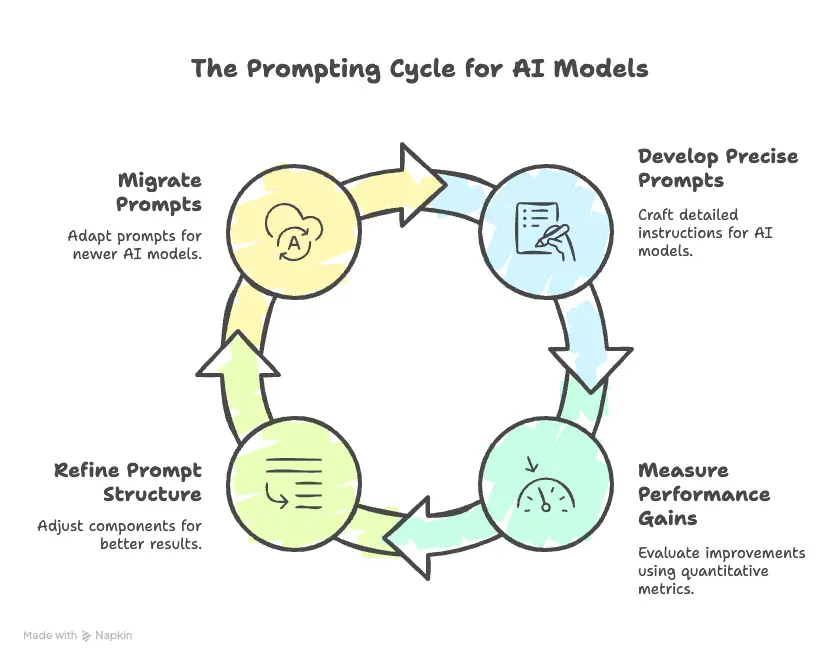
OpenAI’s GPT-4.1 Prompting Guide provides substantial evidence that prompting remains a critical factor in AI performance, directly contradicting predictions that its importance would diminish with newer models. In fact, the guide suggests that prompt engineering may be even more important with GPT-4.1 due to its more literal instruction-following behavior and high responsiveness to well-specified prompts.
The quantitative improvements demonstrated through various prompting techniques (up to 20% performance increase) provide empirical validation for the user’s position on the continued and potentially increased importance of prompting with newer AI models.
Note: this document was created in collaboration with Manus AI